When You’re Fighting for Your Marriage Alone: Where Real Strength Comes From

When You’re Fighting for Your Marriage Alone: Where Real Strength Comes From

*If you’re in an abusive or unsafe marriage, this message is not meant for your situation. God does not ask you to stay in harm’s way. Please seek help, support, and safety. You are deeply valued, and you are not alone.

When You’re Fighting for Your Marriage Alone BlogMarriage can be one of the most beautiful parts of life—but it can also be one of the most painful places to feel alone.

 Maybe you’re the one trying.
The one praying.
The one reading the books, initiating the conversations, suggesting counseling.
And maybe… your spouse isn’t.

If you’re feeling like you’re the only one fighting for your marriage, I want you to hear this loud and clear:

You were never meant to carry your marriage on your own.

When Your Strength Isn’t Enough

We all hit a breaking point when we realize our human strength has limits. It’s discouraging when your best effort still isn’t enough to fix what’s broken.

But here’s the truth—your strength was never supposed to be enough.

Psalm 73:26 reminds us,

“My flesh and my heart may fail, but God is the strength of my heart and my portion forever.”

God never asked you to white-knuckle your way through pain or pretend everything is fine. He simply asks you to bring your weakness to Him—because that’s where His strength comes through the most.

What If My Spouse Refuses to Do the Work?

This may be one of the hardest places to land in a marriage:
You’re ready to grow, you desperately want to heal, and surrender to God—but your spouse is unwilling.

Maybe they don’t want counseling.
Maybe they won’t talk about deeper issues.
Maybe they’ve checked out emotionally or spiritually.

And you’re left wondering, “How can this work if I’m the only one working?”

Here’s the hope:
God can still work in your marriage—even when your spouse won’t.

Psalm 46:1 says,

“God is our refuge and strength, an ever-present help in trouble.”

God doesn’t disappear when your spouse pulls away. In fact, He often draws nearer. He sees your effort. He honors your faithfulness. And He promises to carry you when it feels like you can’t carry anything—or anyone—else.

What Can You Do?

While you can’t change your spouse, here’s what you can do:

  1. Anchor Yourself in God’s Truth

Your worth is not measured by your spouse’s choices.
God’s love for you is unshakable, and your obedience is not wasted.

Isaiah 40:29 says,

“He gives strength to the weary and increases the power of the weak.”

  1. Pray—But Release Control

Yes, pray for your spouse. But don’t make their transformation your responsibility.
Ask God to do what only He can do in their heart—and rest in knowing He’s at work even when you can’t see it.

  1. Protect Your Heart with Boundaries

Boundaries are not about punishment—they’re about protecting what’s healthy.
If your spouse isn’t pursuing God, that doesn’t mean you stop. Keep growing, keep guarding your peace, and don’t compromise your walk with Christ.

  1. Find Safe, Godly Support

Don’t walk this road alone. Talk to a counselor, a mentor, or a trusted friend who can offer support without judgment. Sometimes the most spiritual thing you can do is simply ask for help.

A Final Word of Hope

Even if you're spouse isnt' showing up, God always will2 Corinthians 12:9-10 says,

“My grace is sufficient for you, for my power is made perfect in weakness… for when I am weak, then I am strong.”

This isn’t just true in theory—it’s true for you.

If your marriage feels one-sided right now, don’t give up.
God isn’t finished with your story.
And even if your spouse isn’t showing up, God always will.

Your role is to stay close to Him. To listen for His voice. To obey what He is asking you to do today—even if your spouse isn’t willing to join you yet.

Because when your strength runs out, His never does. None of this guarantees the outcome you may be desiring, but if you abide in the Lord, His direction will be clear, and His grace will be sufficient. He will make straight the path to follow going forward.

Reflection Questions:

  • Where am I relying on my own strength instead of leaning into God’s?
  • What’s one area in my marriage I need to surrender today?
  • Who can I invite into my journey for support?

If this resonates with you, we want you to know—we’re with you.
And more importantly, God is with you. He’s holding you, equipping you, and working even when it feels like nothing’s moving.

You are not alone.

Find more paid and free resources at www.expeditionmarriage.org

Want More?

Listen in as we discuss this issue on Ep. 142: When You’re Fighting for Your Marriage Alone on the Expedition Marriage Podcast.

—Chris & Jamie
Expedition Marriage

[dipl_posts_ticker _builder_version=”4.27.4″ _module_preset=”default” theme_builder_area=”post_content” ticker_label=”Recent Posts” hover_enabled=”0″ sticky_enabled=”0″][/dipl_posts_ticker]
Feeling Stuck in Your Marriage? You’re Not Alone

Feeling Stuck in Your Marriage? You’re Not Alone

Feeling Stuck in Your Marriage? You’re Not Alone

If your marriage feels stuck right now—like no matter what you try, nothing is working—I want to remind you of something important:

You are not alone.

Maybe you’ve done the work.
You’ve had the conversations, read the books, scheduled the date nights, and prayed all the prayers.

But the disconnect is still there. The hurt still lingers. The changes you long for seem slow… or even non-existent.

And maybe, deep down, you’re beginning to wonder if anything you do even matters.

Here’s something to hold onto today:

“The opposite of stuck isn’t unstuck. It’s moving.”

Sometimes being stuck isn’t about doing something wrong. It’s about not knowing what else to do. And because of that, over time, we stop moving. We shut down. We settle into disappointment and stop believing anything will change.

But what if your stuckness is actually serving you in some way?

That’s a hard question—but an important one.

How might staying stuck actually be serving me?

  • Is it protecting me from hoping again—because if I hope, I might be disappointed?
  • Is it helping me stay small, where it feels safer and more familiar?
  • Is there a lie I’m believing—like “This will never change” or “It’s all up to me”—that keeps me from healing?
  • Have I developed a loyalty to my stuckness, because more of a victim mentality feels easier than risking vulnerability or trust?

Here’s what I know: God didn’t create you—or your marriage—for survival mode. He created you for abundance and growth.

Romans 12:2 says,

“Do not conform to the pattern of this world, but be transformed by the renewing of your mind.”

So if your heart is weary today, start with a shift in mindset. Ask God to renew your hope. To highlight the lies that need replacing. To show you just one small step you can take toward connection, healing, and restoration.

Because you don’t have to fix it all. You just have to keep moving—with Jesus leading the way.

There is hope. Even here. Even now.
Don’t stop. Just take the next step.

*This blog is not intended for anyone in a toxic or abusive marriage. If this is you, let someone know or seek professional help

*Disclaimer: The information discussed in this podcast is meant for entertainment purposes and is not meant to replace counseling or working with a trained healthcare professional.

7 Things Your Husband Would Love to Hear 

7 Things Your Husband Would Love to Hear 

7 Things Your Husband Would Love to Hear

Husbands often get a reputation for being emotionally simple—but underneath their composed exterior, many of them wrestle with insecuritiesfeelings of failure, and the pressure to provide. As wives, we have the power to speak truth over those difficult areas and breathe confidence into their hearts.

Here are seven messages every husband wants and needs to hear from their wife:

  1. “I believe in you.”

Even the most confident man needs to know his wife’s supports him and more importantly believes in him. Saying this lets him hear, “I see you. I trust you. I’m behind you all the way.”

  1. “It’s okay to take time for yourself.”

Men often feel guilty about or dismiss their need to take care of themselves. Remind your husband that rest, hobbies, or time with friends isn’t selfish—it’s necessary for his well-being. Tell him it’s okay to take the time and then help him find the time to take.

  1. “I appreciate your efforts.”

Too often, a husband’s hard work—both seen and unseen—goes unnoticed. A heartfelt “thank you” lightens his load and tells him his sacrifices matter. Your gratitude will go a long way.

7 Things Your Husband Would Love to Hear

  1. “It’s okay to fail—you’re still capable.”

Many husbands fear failure more than anything. Let him know that mistakes don’t define him; they’re part of growth. Your encouragement gives him permission to try again. Want more on husbands and fear of failure? Check out https://expeditionmarriage.org/podcast/ep-33-what-wives-need-to-know-about-husbands-and-failure/?utm_source=chatgpt.com

  1. “I don’t hold the past against you.”

Release past hurts and truly let them go. When a husband knows he isn’t under continuous scrutiny, he’s more likely to live and love courageously. There’s a lot of power in forgiveness for both you and your husband.

2 More Things Every Husband Needs to Hear

  1. “I respect the leader I see in you.”

Whether he’s leading prayers at the table or making tough calls at home, it matters when his wife acknowledges his role. Respect empowers him to step into his God-given calling with confidence—and paves the way for mutual submission and unity.

  1. “I trust your heart.”

In a world that’s full of suspicion and pressure, telling your husband you believe in his intentions communicates security—and God-honoring trust. Letting your husband know that you believe he is for you and for what is good, will provide him relief from any burden of his character being doubted.

Speak Life Over Your Husband

Why This Matters

Every kind word you give your husband will help form the foundation of his emotional resilience. When he hears these truths, especially from you:

  • He feels valued instead of overlooked
  • He’s more likely to rest in the safety of your marriage and your heart
  • His confidence in leadership and character grows
  • He’s empowered to love you and your family well

Letting your husband hear your heart—even in simple, everyday moments—can completely shift the atmosphere of your marriage. It doesn’t need to be grand: a note, a casual “thank you,” or a hug after a long day can say more than words ever could.

Want some handy reminders?

Download our “Encouraging Things to Say to Your Husband” cheat sheet—filled with easy, and hopefully authentic to you phrases that can create genuine connection (link here).

Next Step Challenge

Pick one of these seven truths and speak it to your husband this week. Maybe say it out loud, text it, or write it down—Be so genuine that he really feels it.

Marriage isn’t just about surviving—it’s about speaking life, grace, and love into the heart of the man who’s on this lifelong journey with you.

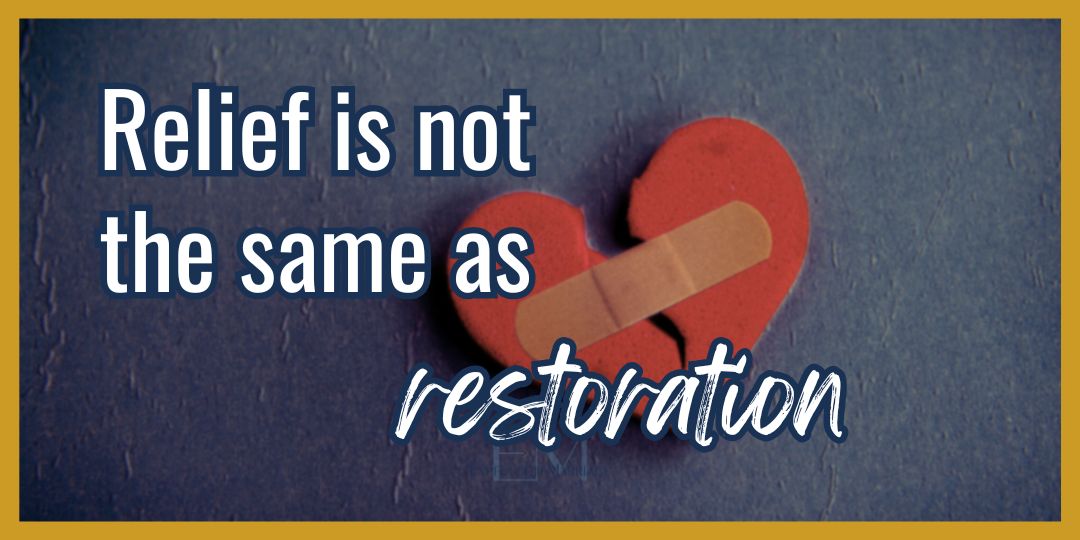
Is Your Marriage Settling for Relief Instead of Restoration?

Is Your Marriage Settling for Relief Instead of Restoration?

Have you ever found yourself just wanting a little relief in your marriage?

Maybe the conversations have grown stale.
Maybe you’re feeling more like roommates than soulmates.
Or maybe it’s just been a long week, and the tension in your home feels heavy.

You’re not in crisis—but you’re not exactly thriving either.

In those moments, it’s easy to reach for relief. A movie night to avoid talking. Scrolling your phone to check out for a bit. A quick laugh or a busy schedule to distract you from the quiet disconnection.

But here’s the hard truth I was reminded of recently while listening to a podcast interview with John Eldredge:

“We’re constantly reaching for relief, when what we really need is restoration.”

6 milestones to celebrate in your marriage

That hit me.

Because relief—while comforting—is temporary. It’s surface-level. It makes us feel better for a moment but never truly heals anything.
Restoration, on the other hand, goes deeper. It brings things back to life. It revives what’s been slowly fading. It addresses the root, not just the symptoms.

And in marriage, we need restoration far more than we need temporary relief.

Even if your marriage isn’t in a crisis, it might be stuck in something just as dangerous: mediocrity, boredom, or quiet disconnection.

When we settle for relief in those moments, we risk growing numb to the slow drift between us. We start surviving instead of thriving. We accept fine when God has something far better in mind. 

The good news? God is a God of restoration.

He doesn’t just patch things up—He makes all things new. (Revelation 21:5)
He doesn’t just want us to get through marriage—He wants us to flourish in it.

So if you’ve been feeling the pull toward surface-level solutions lately, let this be your gentle nudge:

Don’t stop at relief.

Press in for restoration.

Invite God into the quiet places of your marriage.
Have the honest conversations you’ve been putting off.
Ask Him to breathe new life into the parts that feel weary or routine.

Because your marriage was never meant to settle for just “getting by.”

It was created to reflect the beauty, grace, and restorative power of a God who brings dead things back to life.

And He’s not done writing your story.

Need help moving from relief to restoration?
Check out our free resources and counseling options at ExpeditionMarriage.org — we’re here to walk with you every step of the way.

Want a Closer Marriage? Start with a Closer Walk with God

Want a Closer Marriage? Start with a Closer Walk with God

When you see a strong, connected marriage, you can be sure of one thing—it didn’t just happen by chance.

A closer marriage is the result of two people intentionally showing up for each other. It’s built in the daily choices: carving out time together, having meaningful conversations, laughing, forgiving, supporting one another through life’s highs and lows. That kind of closeness is a byproduct of connection—and that connection requires time and investment.

But here’s something we often forget: our relationship with God works the exact same way.

We can’t expect to feel close to our spouse if we’re not spending quality time with them. And in the same way, we can’t expect to feel close to God if we’re not regularly making space for Him in our lives. Time in prayer, in His Word, and simply being in His presence—it all matters. It shapes us.

Closer Marriage

And here’s why that connection to God is essential for a healthy marriage:

When we prioritize our relationship with God, we become better spouses. We grow in patience. We become more forgiving, more humble, and more loving—not because we’re trying harder, but because we’re being transformed by His Spirit. He changes us from the inside out.

That’s why a thriving marriage starts with a thriving faith.

Jesus put it this way in John 15:5 (NIV):

“I am the vine; you are the branches. If you remain in me and I in you, you will bear much fruit.”

That fruit—love, joy, peace, patience, kindness—is what feeds our marriage and sustains us through every season.

Without staying connected to the Vine, we wither… and our relationships suffer too.

So, if your heart is longing for a deeper connection in your marriage, start by drawing closer to Christ.
If you want to feel more united as husband and wife, begin by staying united with Him.

Because the closer you are to God, the closer you can become to each other.

Thriving marriage

Do you feel like you are all alone in your marriage?

Are your schedules so busy with work and taking care of your family that you are simply too tired to connect?

Wouldn't it be great if you could move from exhausted and alone to connected and supported?

To feel like you were part of a team?

Use Coupon Code: PODCAST20
for 20% off the regular price of $34.97

Your Phone Might Be the Devil’s Favorite Device in Your Life

Your Phone Might Be the Devil’s Favorite Device in Your Life

A Reflection on Distraction, Intimacy, and Taking Your Attention Back

My husband and I recently had one of those conversations—the kind that makes you stop and re-evaluate what’s quietly taking over your life. This time, it was about our phones.

We’d already started making some big changes in how we use them, but something about that conversation stirred something deeper in me. Out of curiosity, I looked up the definition of the word “device.” (Yes—on my phone, ironically enough.)

Here’s what I found:
A device is “a deceit or plan to trick.”

Oof. That one hit me, but also didn’t shock me.

Suddenly, I started to see things more clearly. How often is that “innocent” scroll really just a trap? How often does that little ding or buzz pull us away from what actually matters? The enemy is clever—he doesn’t always storm in with chaos. Sometimes, he just gently lures us with distraction… dressed up as entertainment, comparison, or even productivity.

Distraction in Marriage

Distraction Is Spiritual

Let’s call it what it is: many of us are spiritually disconnected—not because God has gone silent, but because we’ve stopped listening.

We’ve traded quiet time for screen time.
Communion with Christ for connection with content.
Real presence in our marriages for mindless scrolling.

And the most tragic part?
We barely notice it happening.

Our phones aren’t evil in themselves. They’re tools.
But they become traps when they start stealing our dependence, our attention, and our peace.

Who Has More Access to You—Your Phone or Your Savior?

That’s the question I had to wrestle with.
And maybe it’s one you need to ask yourself, too.

Jesus hasn’t moved.
He hasn’t stopped speaking.
But maybe we’ve just forgotten how to be still long enough to hear Him.

The constant noise, the pull of endless content, the dopamine hits from likes and notifications—it’s all shaping our spiritual attention spans. And if we’re not careful, we’ll raise children who can’t sit in silence and we’ll grow marriages that struggle to thrive without a screen in the room.

The Call Back to Stillness

Here’s the good news:
You can take your attention back.
You can shut down the noise and open up space for something better.

  • You can put your phone down and pick up God’s Word.
  • You can re-learn how to sit with Him.
  • You can begin to hear again.

And yes, at first, stillness might feel awkward.
You’ll be tempted to reach for distraction.
But stay with it.

Stillness is where intimacy grows. It’s where God whispers. And it’s where peace begins to replace pressure.

Stillness in Marriage

For the Sake of Your Marriage

This isn’t just about your quiet time—it’s about your relationship.
If you’re like many couples today, chances are your phone has become a source of tension in your marriage.

How many times have you heard:
“Can you just put your phone down for a minute?”
“Are you even listening to me?”

It’s time to stop letting a device create distance in our closest relationships.

Let’s not allow something in our hands to steal the intimacy we were meant to have—with God and with each other.

A Prayer to Refocus

Lord, help me to recognize the distractions that pull me away from You. Give me the strength to choose stillness, to quiet the noise, and to tune my heart to Your voice again. Help me love You with my attention. And help me love my spouse with my presence. In Jesus Name, Amen.

If this hits home for you, maybe it’s time for a little phone reset.
Not because it’s trendy—but because your soul needs space to breathe.
And your marriage? It needs presence more than pixels.

Let’s take our attention back—together.

Do you feel like you are all alone in your marriage?

Are your schedules so busy with work and taking care of your family that you are simply too tired to connect?

Wouldn't it be great if you could move from exhausted and alone to connected and supported?

To feel like you were part of a team?

Use Coupon Code: PODCAST20
for 20% off the regular price of $34.97

Embracing Hard Truths in Marriage: Why Emotionally Satisfying Answers Won’t Bring Healing

Embracing Hard Truths in Marriage: Why Emotionally Satisfying Answers Won’t Bring Healing

The other day, I listened to an eye-opening podcast interview with Lisa Fields, an author and apologetics teacher. She shared something powerful about what it means to wrestle with God, and it immediately struck a chord with me. Lisa pointed out that, as believers, many of us struggle when the answers we receive from God don’t meet our emotional expectations. She said, “For many of us, our goal line for God is emotionally satisfying answers. If the answers aren’t emotionally satisfying, we struggle to accept them or believe they’re true.”

I couldn’t help but reflect on how this applies not only to our faith journeys but also to our marriages. We’ve all had those moments where we’re wrestling with God—asking questions like, “Why does this have to happen?”“Why isn’t this fair?”, or “Why should I forgive them when I’ve been hurt so badly?” The truth is, those moments of wrestling often come because we’re searching for answers that feel good, rather than the ones that are grounded in truth.

Why We Gravitate Toward “Comforting Lies”

Have you ever watched the TV show Catfish? The whole premise of the show is to help people uncover whether they’ve been deceived by someone pretending to be someone else online. Or perhaps you’ve seen an episode of Dr. Phil where someone, often an elderly widow, has been scammed into believing a far-fetched love story, even as their bank account is drained. In both cases, the victims are presented with all the evidence they need that they’re being lied to—but they still struggle to believe the truth.

It’s frustrating to watch because, as outsiders, it’s easy to see the blatant red flags. The lies are obvious: someone says they’re from Atlanta, but they have a foreign accent; they constantly need financial help for emergencies, but they can never meet in person. And yet, despite factual proof, the victims don’t want to believe they’re being deceived. The reason? The truth is painful. Emotionally, it’s easier to believe the comforting lies than to face the reality of the situation.

embracing hard truths in marriage title image

How This Relates to Marriage

The same thing happens in our marriages. We may find ourselves in difficult situations—maybe it’s ongoing conflict, resentment, or unmet expectations—and instead of addressing the real issues, we look for emotionally satisfying answers. We may think, “If they would just change, everything would be fine,” or “I’ll feel better once this problem goes away.”But the reality is that avoiding hard truths only prolongs the pain. In fact, it often makes things worse.

I’m not sure what struggles you may be facing in your marriage right now, but here’s what I do know: searching for the answers that make you feel better won’t fix the problem. It will only delay your healing. Whether it’s the need to forgive, to work through past hurts, or to address ongoing issues, it’s time to confront the truth.

Embracing the Hard Truths with God

As difficult as it may be to accept, God’s truth is what will set you free in your marriage. It’s easy to fall into the trap of ignoring the Holy Spirit’s nudges because the truth feels too painful or hard to deal with. But here’s the thing: God’s truth isn’t just something to accept—it’s something that can liberate you and your marriage.

Ignoring hard truths in favor of emotionally satisfying answers may bring temporary relief, but it doesn’t bring lasting peace. It’s like putting a bandage over a deep wound instead of getting the stitches you need for real healing.

So, whatever it is that you’re avoiding, whatever truth you know in your heart that you need to face—take the first step today. Whether it’s a difficult conversation with your spouse, addressing a long-standing issue, or confronting something within yourself, know that God will walk with you through it. He will guide you, sustain you, and bring healing to your marriage.

embracing the hard truths in marriage quote image

God’s Truth Is the Foundation for Healing


In John 16:13, Jesus promises, 
“But when He, the Spirit of truth, comes, He will guide you into all the truth.” The Holy Spirit is our constant companion, ready to guide us toward truth, even when it’s hard to hear. The truth may not always be emotionally satisfying, but it’s where real healing begins.

God’s truth in your marriage may require difficult choices, painful admissions, or a willingness to let go of the emotionally satisfying answers you’ve held onto. But it’s only by embracing the truth—no matter how hard—that you’ll find the freedom and healing you’ve been longing for.

Take heart in knowing that God is with you. He is Truth, and His truth will sustain and guide you, no matter how tough the journey may seem. Trust Him to lead you and your marriage into a place of healing, peace, and restoration.

Moving Forward in Truth

I encourage you today: whatever the hard truth is that you’ve been avoiding, face it with courage and trust in God. Stop searching for answers that simply soothe your emotions and start seeking the truth that will set you free. Your marriage is worth the work. The freedom that comes from living in God’s truth is far better than any temporary comfort you may find in avoiding it.

Remember, God is with you through it all, and His truth will ultimately lead you to the healing and peace you desire in your marriage.

By shifting the focus from seeking emotionally satisfying answers to embracing God’s truth, we can experience the kind of freedom and healing that transforms our marriages. Let’s trust in His guidance and walk in the truth that only He can provide.


If you need help walking through a tough season in your marriage, we’re here to help with virtual marriage coaching and counseling. Check out our services HERE.

5 ways to Deal with Family at the Thanksgiving Table

5 ways to Deal with Family at the Thanksgiving Table

Thanksgiving is almost here, and if you’re like the average couple, you’re gearing up for that annual feast with family—full of turkey, stuffing, and just a sprinkle of chaos. Now, you probably love your family, but let’s be honest, getting through Thanksgiving dinner with everyone’s sanity intact can sometimes feel like a miracle on par with feeding the 5,000. But don’t worry, I’ve got some practical (and slightly humorous) Christian advice to help you navigate the turkey, the tension, and everything in between.

1. Pray Before You Feast—and Not Just for the Food

Let’s start with the obvious: prayer. Before that turkey even hits the table, take a moment to pray. And I’m not just talking about blessing the meal—though that’s important too. Pray for patience, kindness, and the strength to smile when Aunt Mildred asks you for the fifth time why you haven’t had any more kids yet. Consider prayer like the stuffing to your Thanksgiving turkey—it fills the gaps and holds everything together.

 And hey, if you’re hosting, sneak in an extra prayer while you’re basting the turkey. You’ll need it when Uncle Joe starts discussing politics before dessert.

2. Serve a Side of Grace with That Gravy

Thanksgiving is a time to be thankful, but sometimes, it’s also a time to bite your tongue. When Cousin Larry starts talking about his latest conspiracy theory, or when Grandma insists that her “secret” recipe is better than yours, remember that grace is key. Pour out that grace like gravy and remind yourself that Thanksgiving is more than the meal—it’s about the people around the table.

So when the conversation gets a little heated, or you feel your patience wearing thin, take a deep breath, pass the mashed potatoes, and keep serving up that grace. You’ll feel better for it—and so will everyone else.

 3. Focus on the Blessings, Not the Bickering

It’s easy to get caught up in the bickering that sometimes bubbles up around the Thanksgiving table. But instead of focusing on what’s wrong, why not focus on what’s right? Take a moment to look around the table at the faces of the people you love (even if they’re driving you a little crazy), and be thankful for each one of them. Yes, even the one who chews obnoxiously loud.

thanksgiving table decor

Remember, every family has its quirks, but those quirks are part of what makes your family unique. And who knows? Maybe one day you’ll look back on these moments and laugh—after all, humor is one of God’s best gifts.

4. Create a “Thankful for” Tradition

Here’s a little tip I’ve found helpful: before diving into the turkey, go around the table and have everyone share something they’re thankful for. It’s amazing how this simple act can set a positive tone for the entire meal. Plus, it’s a great way to remind everyone (including yourself) of the many blessings God has poured into your lives.

And if anyone tries to skip out on sharing, feel free to gently remind them that there’s always something to be thankful for—like the fact that the turkey isn’t raw or burnt this year.

5. Laughter Is the Best Dessert

Finally, remember that laughter is truly the best dessert—well, right after pumpkin pie, of course. When the conversation starts getting tense, try lightening the mood with a joke or a funny story. Laughter can diffuse tension faster than you can say “pass the cranberry sauce.”

So, whether it’s reminiscing about funny family moments or telling a good-natured joke, don’t be afraid to bring a little humor to the table. It might just be the secret ingredient to a peaceful and joyful Thanksgiving.

Giving Thanks Together

At the end of the day, Thanksgiving isn’t about having the perfect meal or the perfect family—it’s about coming together to give thanks to God for all He’s done. It’s about remembering that despite our differences, we are all loved and blessed beyond measure.

So this Thanksgiving, let’s focus on what really matters: faith, family, and a whole lot of gratitude. And if things get a little messy—whether it’s the gravy or the conversation—just remember to laugh, pray, and pass the pie.


Wishing you a Thanksgiving full of love, laughter, and God’s abundant blessings!

thanksgiving is about blessings
Navigating Intimacy: 7 Tips for When You Have a Higher Sex Drive than Your Husband

Navigating Intimacy: 7 Tips for When You Have a Higher Sex Drive than Your Husband

We live in a society where it’s not uncommon to hear about the great need for sex that men have. But the truth is that God designed sex for both husbands and wives, and how much or how little they each desire sex can be varied. It is true that more men statistically have higher sex drives than their wives, but in 1 out of every 4 marriages, it’s the wife who has the higher drive. 

What do you do in this stigmatized situation that feels like things are backward?

As a woman with a higher sex drive, it’s likely that your first instinct is to wonder why you’re not desirable to your husband. This form of thinking is self-protective and likely not even close to being the reality of the situation.

There are many reasons why our sex drives are different, and they’re usually not related to our spouse’s attractiveness. It’s actually far more likely for a wife not to have sex with her husband for this reason than it is the other way around. But constantly asking your husband if he’s attracted to you or questioning why he isn’t will not head you in the direction you’d like to go.

For starters, mismatched sex drives are entirely normal. When it can become a problem is when there are sudden drops in libido, slow fades because you’re disconnected as a couple, or when other health issues or aging are factors. Some of these can be addressed and fixed, and others you can learn to adjust to in beautiful and healthy ways. The couple affected by chronic pain, medical issues, or just the aging couple can all still have great sex.


Here are some insights and practical tips to foster a healthy and satisfying intimate connection when sex drives differ:


  1. Open and Honest Communication:
    Good communication is important when it comes to the health of a marriage, especially when it comes to physical connection. Good communication leads to emotional connection, which often leads to physical connection. Believe it or not, husbands want emotional connection, too.
higher sex drive

    You also need to have an open and honest conversation with your husband about your respective needs, desires, and expectations. Create a safe space where both of you can express your feelings without judgment. Make inquiries about health, his mental and physical state, stress levels, or any obstacles that may decrease his libido. Determine if he’s worried about it or if he feels your sex drive is just higher. 

    1. Understand Each Other’s Perspectives:
      Take the time to understand each other’s perspectives on intimacy. Acknowledge that everyone’s libido is unique, and factors such as stress, health, and personal experiences can influence it. Understanding one another’s point of view will foster empathy and strengthen your emotional connection.
      If your husband says it’s not a lack of desire for you, believe him. If you disregard how he really feels, you will likely make him feel inadequate or defective in some way. Remember, a lower sex drive for him can be entirely normal and does not signify a problem, so it’s important to make him feel like he is not flawed in this area.
    1. Prioritize Quality Over Quantity:
      Focus on letting quality trump quantity when it comes to intimacy. Instead of focusing solely on frequency, concentrate on the quality of your intimate moments. Ensure that both of you feel emotionally connected and satisfied, regardless of the frequency. When you are physically intimate, be fully present and make the most out of it. 
    1. Schedule Intimacy:
      While it may sound unromantic, scheduling intimacy can be a practical solution to ensure that both partners’ needs are met. This approach allows for anticipation and planning, creating a dedicated space for intimate connection amidst busy schedules. At the end of the day, we schedule and make room for the things that are important to us.

    5. Seek Professional Guidance:
    If the differences in sexual desire become a significant source of tension, consider seeking the guidance of a marriage counselor. Professionals can provide insights, tools, and strategies to navigate these challenges and enhance intimacy.

    6. Address Potential Underlying Issues:
    If there are potential medical reasons or other underlying issues, such as stress, hormonal imbalances, or unresolved marriage issues, address them. Get hormones checked, see the doctor together, or get counseling. Your marriage is worth it.

    7. Focus on Overall Relationship Health:Remember that a healthy intimate life is just one aspect of a thriving relationship. Focus on nurturing other aspects of your connection, such as emotional intimacy, communication, and shared activities. A well-rounded relationship can contribute to a more fulfilling and harmonious marriage.


    Navigating a situation where you have a higher sex drive requires patience, understanding, and a willingness to explore new approaches.

    By fostering open communication and mutual respect, you can create a space where both of you feel valued and satisfied in your intimate connection. Remember, it’s about finding a balance that works for both of you and enhances the overall well-being of your relationship. Mismatched sex drives don’t have to be a problem to be solved. They can often be an opportunity to connect in so many other ways.

    Want more Christian Marriage content? Check out the Expedition Marriage Podcast with Chris and Jamie Bailey.

    Do you feel like you are all alone in your marriage?

    Are your schedules so busy with work and taking care of your family that you are simply too tired to connect?

    Wouldn't it be great if you could move from exhausted and alone to connected and supported?

    To feel like you were part of a team?

    Only $49.99.